Contents
Quick answer: A dentist with an in-house lab can design, make and fit many crowns, bridges and implant teeth in the same building, often in one visit. The real advantage is communication: the person shaping your tooth can see you, check the shade and fix small problems before you leave. The research shows fit and strength comparable to traditional lab work.
Picture a Tuesday lunch. You bite down on something hard, feel a crack, and run your tongue over a sharp edge that wasn't there this morning.
You already know what comes next. A crown.
And with it, the usual plan: a numbing shot, a goopy impression, a plastic temporary, and two or three weeks of chewing on the other side while a lab you will never visit makes your tooth.
So when you see a dentist advertise an in-house lab, the question is fair. Does it really change anything, or is it a nice line on a website?
The simple answer is… an in-house lab means fewer appointments, no temporary crown in many cases, and less time off work.
The more honest answer is… speed is the least interesting part. What changes most is who talks to whom, how quickly mistakes get caught, and how much of your tooth is designed by someone who has actually looked at your smile.
This post walks through what the research says, where an in-house lab helps, and where it doesn't.
What Is an In-House Dental Lab?
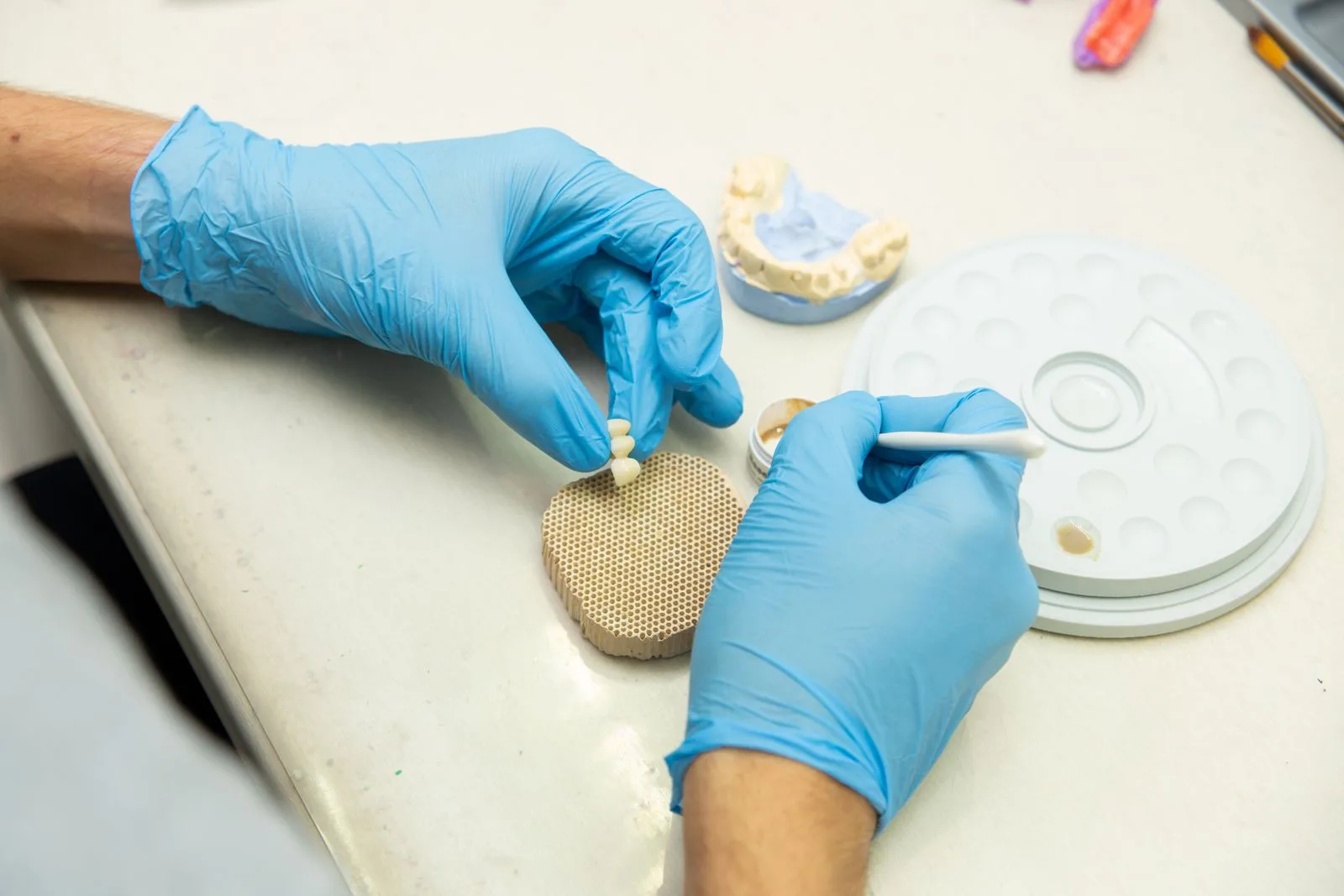
A dental lab is where crowns, bridges, veneers, implant teeth and dentures are made. Most dental offices send that work out to a separate company, sometimes across town and sometimes across the country.
An in-house lab puts that work under the same roof. At Organ Mountain Dental, the tooth is scanned with a digital scanner, designed on screen, and milled in the office lab, mostly from zirconia, with lithium disilicate (e.max) or hybrid materials used in select cases.
If you want the step-by-step version of the visit, our in-house lab and same-day dentistry page covers the process. This post focuses on a different question: why it should matter to you.
The Biggest Difference: The Lab Can See You
With a traditional lab, the technician usually never meets the patient. Everything they know about you comes from a prescription form, an impression or scan, and maybe a few photos.
That handoff is where details get lost. A survey of 66 dental labs found that dentists' written instructions often left out key details such as margin design, staining maps and the type of porcelain wanted (Tulbah et al., 2017).
In interviews with dentists and technicians, both groups described delays from remakes and repairs. Technicians mostly blamed missing or poor-quality information. Both groups said they preferred in-house or nearby labs because they allow one-to-one conversation and direct access to the patient, which matters most for cosmetic work (Ismail & Al-Moghrabi, 2023).
An in-house lab doesn't make anyone smarter. It shortens the distance between the question and the answer.
For patients in Las Cruces and across southern New Mexico and the El Paso area, that shorter distance usually also means fewer drives to the office for a single tooth.

Is an In-House Lab Better Than an Outside Dental Lab?
Neither is better in every case. Here is how they compare on the things patients usually care about.
| What matters to you | In-house lab | Outside lab |
|---|---|---|
| Who designs the tooth | Your dentist and the lab team, a few steps from your chair | A technician who usually never sees you, working from a prescription, records and photos |
| How details travel | Face to face, with you still in the office | Written forms, files and phone calls |
| Typical visits for a crown | Often one, when the tooth and material allow it | Usually two, with a temporary crown in between |
| If something needs changing | Adjusted or redesigned the same day in many cases | Sent back, then another appointment |
| Materials | Limited to what the office can make well on site | Wider menu, including specialty layered ceramics |
| Fit and strength | Comparable to lab work in the research | Comparable to digital work in the research |
The bottom row is important. A good outside lab and a good in-house lab can both make excellent teeth. The differences are mostly about communication, time and convenience.
Do Crowns From an In-House Lab Fit as Well as Traditional Crowns?
Fit is measured by the tiny gap between the crown edge and the tooth. A 2026 meta-analysis of 16 studies found no meaningful difference between digitally milled (CAD-CAM) ceramic crowns and conventionally made crowns, and both stayed under the commonly used 120-micron clinical limit (Yeşil et al., 2026).
The authors also noted that preparation shape, material and the experience of the team matter as much as the method.
A digital workflow doesn't guarantee a good fit. A careful dentist does.
What an in-house lab adds is the chance to check the fit while you're still here. If a contact is tight or your bite feels high, the crown can often be adjusted or redesigned the same day instead of being shipped back.
Are Same-Day Crowns as Strong as Lab-Made Crowns?
Strength depends more on the material than on where it's made. A large review of more than 14,000 single crowns found five-year survival of about 92% to 97% for most all-ceramic types, close to traditional metal-ceramic crowns at about 95% (Sailer et al., 2015).
Full-contour (monolithic) zirconia, the material used for most same-day crowns at our office, showed survival of 91% to 100% in a 2022 meta-analysis, though follow-up was short and one study that included heavy grinders reported far worse results (Leitão et al., 2022).
Digitally milled single-tooth restorations have been studied for decades. An older review of nearly 2,000 CAD/CAM restorations estimated about 92% survival at five years (Wittneben et al., 2009).
So the honest summary is: same-day ceramic crowns hold up about as well as conventional ones in the studies we have. Long-term data on the newest zirconia materials is still growing.
Why Does Shade Matching Go Better When the Lab Is Down the Hall?
Tooth color is hard to put into words. People perceive color differently, and teeth that dry out during treatment can look lighter than they really are, which is why shade is usually chosen before the tooth is prepared (Phelan, 2002).
An outside technician has to rebuild your color from a shade tab, a photo and a note. An in-house team can look at the restoration next to your real teeth, in the same light, and adjust the stain before it's final.
That matters most for front teeth, porcelain veneers and cases where a new crown has to blend with older dental work.
How Much Time Does an In-House Lab Really Save?
For a single same-day crown, our office estimates about 90 minutes to 2 hours from scan to final fit. Multi-unit bridges, implant crowns and full-arch cases can take about 3 to 5 hours. You get a time estimate before treatment starts.
The digital steps help on their own. In a randomized crossover trial, patients rated digital scanning far more comfortable than traditional impressions, and every patient said they would choose the digital method next time (Joda & Brägger, 2016).
A related trial found the full digital workflow for implant crowns took less total clinic and lab time than the conventional pathway (Joda & Brägger, 2015).
The bigger saving is the visit you don't need: no temporary crown, no second numbing, no second trip.
What We Look at Before Recommending a Same-Day Restoration
Same-day isn't automatic. Before we suggest it, we look at a few things:
- How much healthy tooth is left. A badly broken tooth may need a buildup, a root canal or, sometimes, an extraction first.
- Your gums. Inflamed or bleeding gums make scanning and bonding less reliable, so gum health may come first.
- Your bite and habits. Clenching or grinding changes material choice and may mean a night guard.
- Where the tooth is. Back teeth usually favor zirconia for strength. Front teeth may call for a more translucent ceramic.
- Bone and implant planning. For implant work we use 3D CBCT imaging to check bone first. Some cases need grafting and healing before final teeth.
- The bigger plan. One crown may be part of a larger plan, and doing it in stages can be smarter than doing it fast.
The same thinking applies to dental bridges, implant restorations and zirconia full-arch bridges. Speed is a bonus, not the goal.
What Are the Risks and Limits of In-House Lab Dentistry?
An in-house lab is a strong tool, but it has real limits:
- Fewer material options. An office makes what its equipment does well. Some specialty materials, such as hand-layered porcelain, may still be best from an outside specialist lab.
- Longer single visit. One longer appointment replaces two shorter ones, which isn't ideal for everyone.
- Not every case is same-day. Infection, gum disease, bone loss or a complex bite may need staged treatment.
- The usual crown risks still apply. Chipping, loosening or fracture can happen with any crown. Zirconia crowns in the reviews above had more loss of retention and chipping of layered porcelain than metal-ceramic crowns.
- Short-term data on new materials. Many zirconia studies have only a few years of follow-up.
A good dentist will tell you when the traditional route is the better choice.
How Much Does a Crown From an In-House Lab Cost?
Our office says same-day crowns generally cost about the same as traditional crowns, sometimes less. The exact fee depends on the tooth, the material and whether you need other treatment first, so we give you a written estimate after your exam.
Most dental plans cover a same-day crown the same way they cover a lab-made one, because coverage is based on the procedure, not where the crown is made. We accept most major PPO plans and check your benefits before treatment. Financing through CareCredit and Cherry and our in-house dental plan are explained on our insurance and payment page.
For implants specifically, our guide to dental implant insurance explains annual maximums, waiting periods and missing tooth clauses.
For missing teeth, our current single implant special starts at $4,999. What's included depends on your case, so ask during your consultation.
If you're weighing an implant against a bridge, our post on the benefits of replacing missing teeth with implants is a good next read, and if you wear a lower denture, see the problem with lower dentures.
Final Takeaways
- An in-house lab lets your dentist design, make and fit many crowns, bridges and implant teeth in one building, often in one visit.
- The biggest benefit is communication. Research shows lost details and remakes are common when dentist and lab are far apart.
- Fit and survival of digitally milled ceramic crowns are comparable to traditional crowns in current research.
- Shade matching and small fixes are easier when the lab team can see you.
- It isn't right for every case. Gum health, bone, bite and the overall plan come first.
- Same-day crowns are usually billed and covered like any other crown.
Wondering if your tooth is a good fit for same-day treatment? Book a consultation at Organ Mountain Dental on South Telshor Boulevard in Las Cruces. Call (575) 522-1314 or request an appointment online, and we'll show you your scan, explain your options and tell you honestly whether same-day is the right call.
Research References
- Ismail EH, Al-Moghrabi D. Interrelationship between dental clinicians and laboratory technicians: a qualitative study. BMC Oral Health. 2023;23:682. https://doi.org/10.1186/s12903-023-03395-z
- Tulbah H, AlHamdan E, AlQahtani A, AlShahrani A, AlShaye M. Quality of communication between dentists and dental laboratory technicians for fixed prosthodontics in Riyadh, Saudi Arabia. Saudi Dental Journal. 2017;29(3):111-116. https://doaj.org/article/2a5c20a26e614e0fb5c483844dcb96f3
- Phelan S. Use of photographs for communicating with the laboratory in indirect posterior restorations. Journal of the Canadian Dental Association. 2002;68(4):239-242. https://www.cda-adc.ca/jcda/vol-68/issue-4/239.pdf
- Yeşil İK, Yeşil Ç, Yeşil Z. Marginal gap of ceramic crowns fabricated by CAD-CAM and conventional techniques: a systematic review and meta-analysis. Journal of Prosthetic Dentistry. 2026. https://doi.org/10.1016/j.prosdent.2026.05.016
- Sailer I, Makarov NA, Thoma DS, Zwahlen M, Pjetursson BE. All-ceramic or metal-ceramic tooth-supported fixed dental prostheses (FDPs)? A systematic review of the survival and complication rates. Part I: Single crowns (SCs). Dental Materials. 2015;31(6):603-623. https://doi.org/10.1016/j.dental.2015.02.011
- Leitão CIMB, Fernandes GVO, Azevedo LPP, Araújo FM, Donato H, Correia ARM. Clinical performance of monolithic CAD/CAM tooth-supported zirconia restorations: systematic review and meta-analysis. Journal of Prosthodontic Research. 2022;66(3):374-384. https://doi.org/10.2186/jpr.JPR_D_21_00081
- Wittneben JG, Wright RF, Weber HP, Gallucci GO. A systematic review of the clinical performance of CAD/CAM single-tooth restorations. International Journal of Prosthodontics. 2009;22(5):466-471. https://pubmed.ncbi.nlm.nih.gov/20095195/
- Joda T, Brägger U. Patient-centered outcomes comparing digital and conventional implant impression procedures: a randomized crossover trial. Clinical Oral Implants Research. 2016;27(12):e185-e189. https://doi.org/10.1111/clr.12600
- Joda T, Brägger U. Time-efficiency analysis comparing digital and conventional workflows for implant crowns: a prospective clinical crossover trial. International Journal of Oral & Maxillofacial Implants. 2015;30(5):1047-1053. https://doi.org/10.11607/jomi.3963